What an SME website needs to do
Before you think about design or features, be clear on what job your website is doing. For most small and medium-sized businesses, it is one or more of these:
- Build credibility. When someone hears your name or sees your ad, they will Google you. A professional-looking site says you are real and trustworthy. A bad one loses you the sale before you even speak to the person.
- Generate leads or enquiries. Contact forms, WhatsApp buttons, booking links — the site should make it easy for interested people to take the next step.
- Rank on Google. If your customers search for your service in your city or globally, you want your site to appear. That requires SEO-conscious design from the start.
- Explain what you do. Clearly enough that a stranger understands your offer in 10 seconds.
That is it. Everything else — animations, chatbots, popups, mega-menus — is secondary to those four.
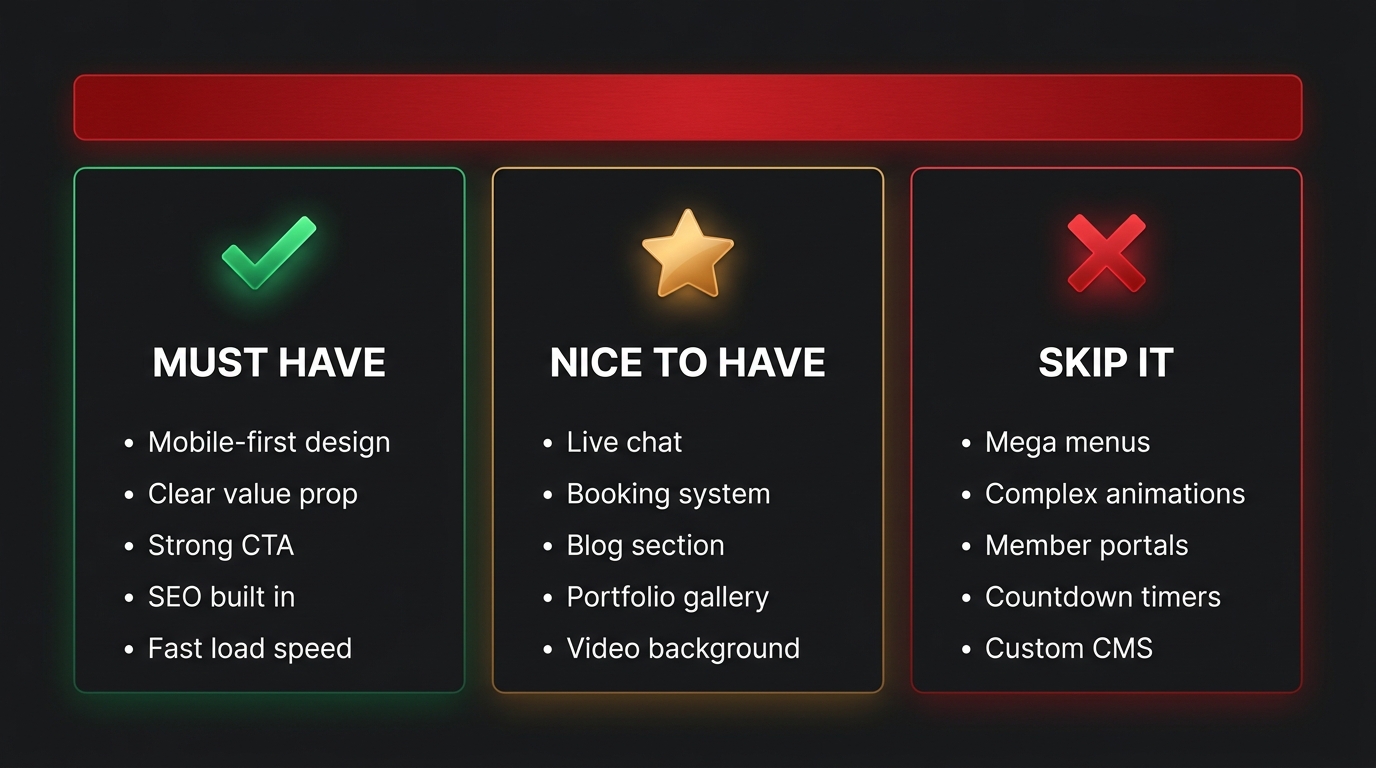
The must-haves for SME website design
A fast, mobile-first design
More than half of web traffic is mobile. If your site is slow or hard to navigate on a phone, you are losing visitors before they read a word. A site that loads in under 3 seconds on mobile is the baseline — not a luxury.
Speed is also a Google ranking factor. A slow site will rank lower than a comparable fast one.
A clear value proposition above the fold
The first thing a visitor sees when they land on your homepage is your value proposition — what you do and for whom. If that is not clear within 5 seconds, most people will leave.
This is not a place for clever slogans. Be specific and plain: “Custom websites for small and medium-sized businesses in Malaysia” beats “Empowering brands through digital excellence” every time.
At least one strong call to action
What do you want people to do? Get a quote, book a call, send a message, visit your store? Pick the most important action and make it impossible to miss. Every page should have a clear, logical next step.
A service or about page that builds trust
People do not buy from strangers. A well-written services page that describes your offer clearly, explains how you work, and ideally shows some social proof (client names, results, photos of real work) is essential.
Do not hide behind vague language. The more specific you are about what you do and who you do it for, the more it resonates with the right visitors.
SEO foundations built in from the start
SME website design and SEO are not separate projects. The decisions made during the build — URL structure, page titles, heading hierarchy, image alt text, internal linking, page speed — all affect how you rank. Build SEO in from day one; retrofitting it is more expensive and less effective.
For local businesses, geo-targeted pages and a Google Business Profile are particularly important.
Contact details that are impossible to miss
Phone number, email, WhatsApp, address if relevant — in the header and footer of every page. You would be surprised how many SME sites make you hunt for contact information.
A blog or guides section (eventually)
Not required on day one, but valuable when you are ready. Regularly publishing helpful content is how you build authority and organic traffic over time. A site built from the start with a blog structure is easier to grow.
What you probably do not need (yet)
A massive feature set
Countdown timers, live chat, complex booking systems, member portals, video backgrounds — these add cost, slow your site down, and create more things to maintain. Add features when your business demands them, not because you think they look impressive.
A big, complex design
The best SME websites are simple. One or two fonts, a clear colour scheme, generous white space. “Simple but polished” outperforms “complicated and busy” in almost every test. Complexity is not the same as quality.
A custom CMS that nobody can edit
Your website should be editable by you (or anyone you hire). If the developer builds something only they can maintain, you are locked in permanently. Build on an open platform like WordPress — it is standard, well-documented, and any competent developer can work on it.
The cheapest option
This is worth saying plainly: a $200 website from a template mill or a freelancer who does not understand SEO is not a deal — it is a waste of the marketing budget you will spend driving people to it. The website is where the conversion happens. It is worth investing in.
What does SME website design cost?
Costs vary significantly by location, provider, and scope. As a global rough guide:
| Type | Cost range |
|---|---|
| Template/DIY (Wix, Squarespace) | $15–60/month |
| Freelance, simple build | $500 – $3,000 |
| Agency, standard SME site | $3,000 – $15,000+ |
| Pay monthly subscription | $80 – $300/month all-in |
For Malaysian businesses, local web design agencies often cost less than global equivalents. See our Malaysia web design page for how we price our work.
For a full breakdown of what drives website costs, read our website cost guide.
DIY vs. hiring a web designer for SMEs
The case for DIY
If you have the time, interest and the site is simple, DIY platforms like Wix or Squarespace are genuinely capable. You save money and you control the timeline.
The trade-off: most SME owners do not have time to learn web design properly, and DIY sites often lack the SEO knowledge to rank. A DIY site that does not appear on Google is not an asset.
The case for hiring someone
A professionally built site — built once, built right — pays for itself if it converts visitors into customers. The question is not “can I afford to hire a web designer?” but “how many customers do I need to win back that cost?”
If your average client is worth $1,000 and a professional site helps you win two extra clients a year, it has paid for itself in month one.
The subscription middle ground
If upfront cost is the barrier, a pay-monthly website subscription gives you a professional build at a manageable monthly cost, with hosting and maintenance included. See how our subscription works →
How Espejostudio approaches SME website design
We build on WordPress with Elementor — the most flexible, widely-used platform for SME sites. Every site is custom (no templates), built with SEO from the ground up, mobile-optimised, and maintained after launch.
We work with small and medium-sized businesses globally and across Malaysia. If you are in Kuala Lumpur, Penang, Johor Bahru, Selangor or elsewhere — the process is the same, and we add local SEO targeting so nearby customers can find you.
You talk directly to the person building your site. No account managers, no ticket queues.
Ready to talk? [email protected] or WhatsApp.
FAQ
What pages does an SME website need?
At minimum: Home, About (or About Us), Services (or What We Do), and Contact. If you have multiple services or serve specific locations, add dedicated pages for each. A blog is valuable when you are ready to invest in content.
How long does it take to build an SME website?
A straightforward 5–8 page site typically takes 2–4 weeks from brief to launch, assuming content (text and images) is provided promptly. Custom features or complex e-commerce take longer.
Do I need a website if I have a social media presence?
Yes. Social media you rent — the platform controls your reach, your content can be removed, and algorithms limit who sees you. A website is yours. It also ranks on Google (social profiles generally do not), and it gives you a place to convert visitors into contacts and customers.
What platform should an SME use for their website?
WordPress powers around 43% of all websites and is the best choice for most small and medium-sized businesses that want flexibility and SEO performance. Wix and Squarespace are simpler to use but have ceilings. See our WordPress vs Wix comparison for the full breakdown.
How do I make my business website show up on Google?
Through SEO — search engine optimisation. It starts with the way the site is built (fast, mobile-friendly, clean URL structure, proper headings) and continues with content that targets the terms your customers actually search. This is why SEO-conscious design from the start matters.
This is what I build every month: web design, paid monthly.